CSCG 2026 Competition Writeup
Solo CTF participation in CSCG 2026, ranking 7th in Malta among ~1,000 participants worldwide.
7th place (Malta) · Solo · ~1,000 participants worldwide
Overview
CSCG (Cyber Security Challenge Germany) 2026 is a large scale international CTF competition drawing around 1,000 participants from across Europe and beyond. Competing solo, I placed 7th among all Maltese participants, working through challenges spanning cryptography, web exploitation, forensics, and reverse engineering.
The competition was a strong test of both breadth and depth: easy challenges reward familiarity with standard techniques, while harder ones demand original thinking and the ability to build custom tooling from scratch. Below are some of the more technically involved challenges I solved.
Cryptography
SHA-1 Length Extension Attack
One challenge used a SHA-1 secret prefix MAC for authentication. The vulnerability: SHA-1’s Merkle Damgård construction means that if you know the hash of a message, you can extend it without knowing the secret. I implemented the full attack from scratch in pure Python, with no external libraries, manually reconstructing the internal hash state and forging a valid authenticated message.
AES-CTR Nonce Reuse
A classic but dangerous mistake: the same nonce used twice under AES-CTR effectively turns the keystream into a one time pad that can be recovered via XOR with known plaintext. I exploited this to recover the keystream and decrypt the target ciphertext.
LCG Cipher Break
This challenge used a Linear Congruential Generator as a cipher. By leveraging known plaintext and modular arithmetic, I recovered the generator’s parameters and decrypted the flag, which was then triple encoded through Base64, NATO phonetic alphabet, and ROT13.
ZIPPER GF(4919) Matrix Hash Forgery
The most algebraically involved challenge I solved. The server used a custom hash built on matrix multiplication over GF(4919), a finite field. The attack had two phases: first, I recovered the secret matrix by analysing information leaked through server error messages. Second, I used that matrix to forge valid gzip files that would pass the server’s verification on each round. Implemented in both pure Python and SageMath.
Web Exploitation
Unicode Path Traversal knowledge base
A FastAPI application backed by ChromaDB applied path sanitisation that could be bypassed using Unicode NFKC normalisation. By substituting U+2025 (which normalises to ..) and U+FF0F (which normalises to /), I was able to traverse outside the intended directory and achieve arbitrary file read on the server.
Forensics
Port Knocking via YouTube Metadata
A packet capture contained a port knocking sequence where the destination port bytes were derived from YouTube video IDs embedded in the traffic. Identifying the encoding scheme and reconstructing the knock sequence from the capture revealed the flag.
Reverse Engineering
Mystical PostScript Cipher
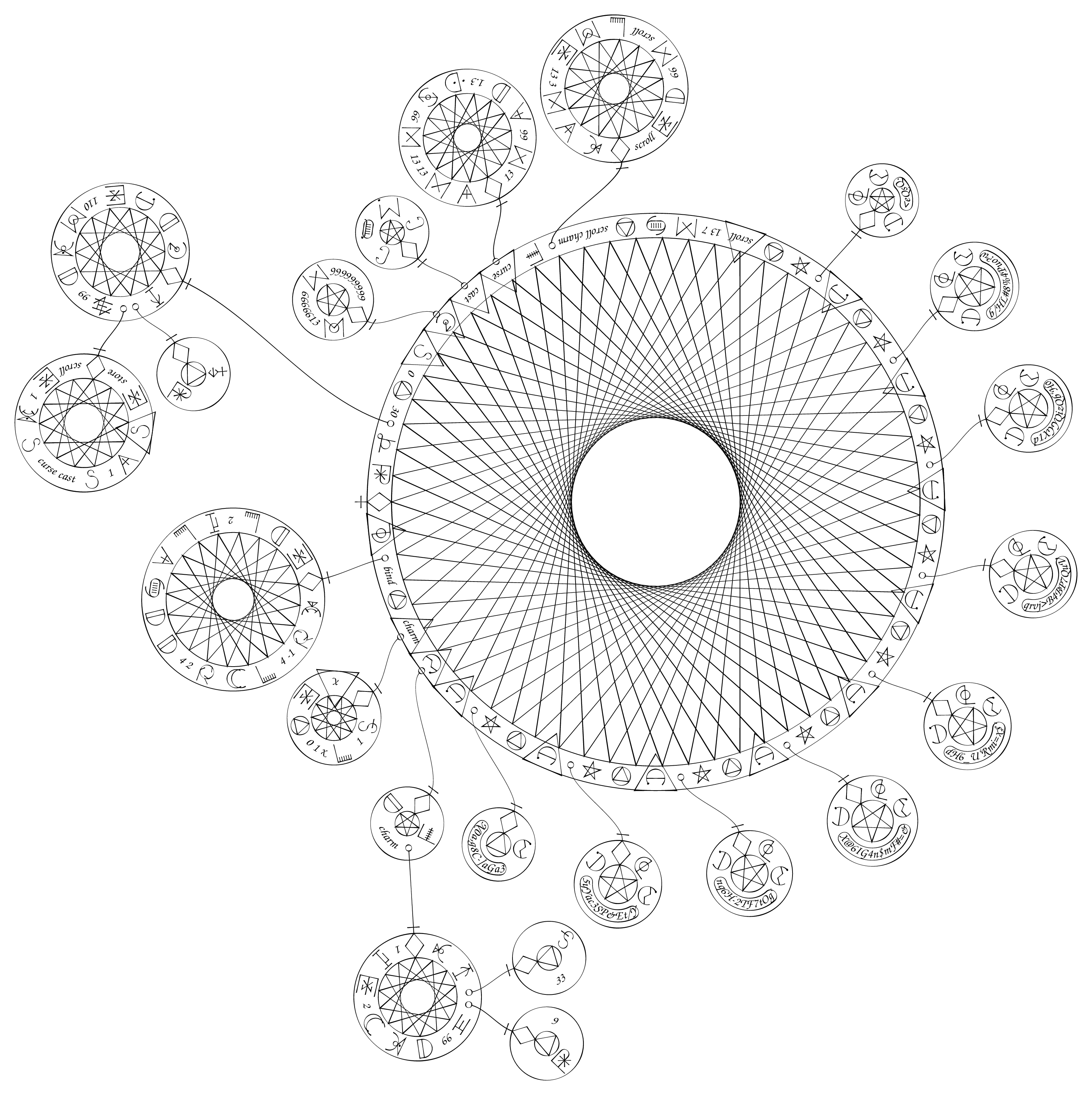
One challenge provided an encrypted artifact that turned out to be a PostScript program encoded with a custom symbolic cipher. The source material was the mystical_ps project by Denis Moskowitz — a PostScript generator that renders magical sigils by mapping text to geometric symbols arranged on a circle.
The challenge artifact was a rendered sigil (shown as the cover image above): a large central circle packed with crosshatch chords, surrounded by a cluster of smaller satellite sigils, each containing its own star polygon and annotated with encoded glyphs. The task was to reverse the encoding and recover the hidden plaintext.
Working through the mystical_ps source, I mapped each glyph back to its corresponding character using the project’s encoding table. Starting from the outer ring of the central sigil and then processing the satellite circles in order, I reconstructed the full plaintext that had been drawn into the image. This required careful attention to the reading direction (the text runs around the ring in a specific rotational order) and to the distinction between letter glyphs, digits, and punctuation symbols.
The flag was embedded in the decoded satellite labels, confirming the full decryption.
Reflections
Competing solo in a field of ~1,000 meant every flag required independent problem solving with no safety net. The challenges I found most rewarding were those that required building attacks from first principles, particularly the SHA-1 length extension and the GF(4919) forgery, where no off the shelf tool would do the job. CSCG 2026 reinforced my interest in pursuing a career in cryptographic and systems security.