Young European Security Conference 2026
Participating in and leading a working group on Cyber Conflicts & Critical Infrastructure at the YESC, a two-day security policy conference for young Europeans in Berlin.
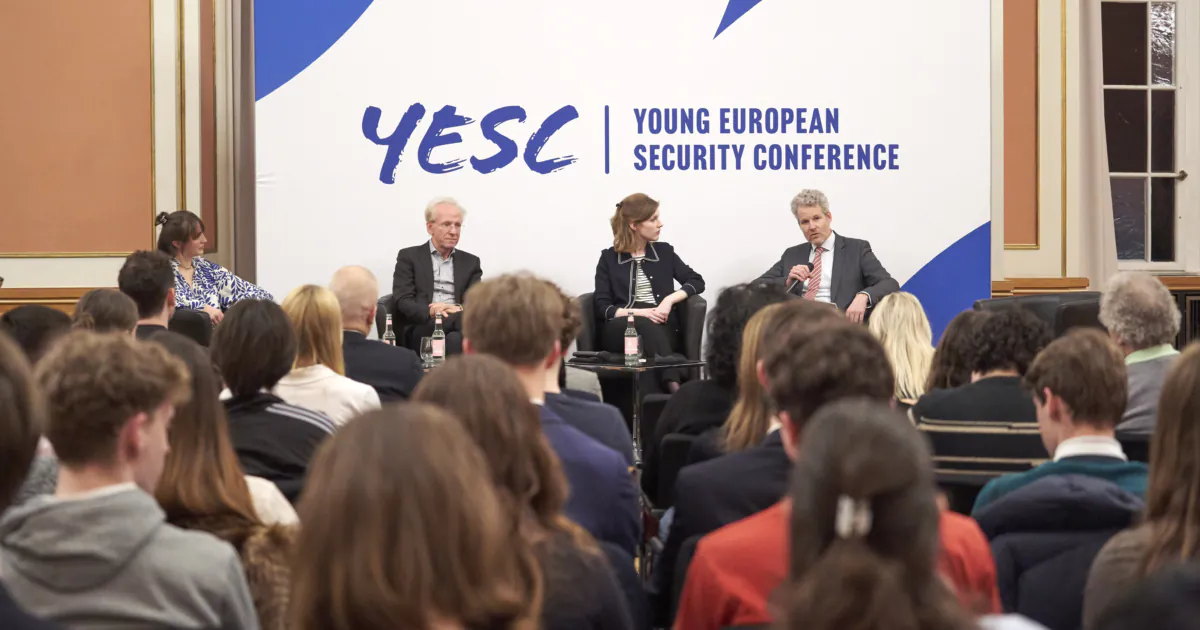
In late February 2026, I had the opportunity to join around 200 young Europeans in Berlin for the Young European Security Conference (YESC), a two-day initiative organised by the Schwarzkopf Foundation Young Europe and the Hertie Foundation, dedicated to security policy education and youth engagement.
About the conference
The YESC brought together participants aged 16 to 21 from across the continent at a moment when international conflicts and security issues feel more pressing than ever. The programme was deliberately hands-on: working groups, a World Café, expert discussions, and a ceremonial closing session where working-group outcomes were presented to high-level guests.
What made the format particularly effective was its insistence on giving young people genuine ownership of the debate (not just as an audience, but as contributors whose perspectives are intended to travel further than the conference hall).
“Security is no longer an abstract concern for governments alone. It’s a conversation that every generation has a stake in shaping.”
My working group: Cyber Conflicts & Critical Infrastructure
Participants were assigned to working groups across a range of security topics, offered at two levels (Intro and Advanced) to accommodate different backgrounds. I was placed in the Advanced track, and had the privilege of leading the discussion within our group.
Advanced 2: Working Group
Cyber Conflicts & Critical Infrastructure: What Happens When Systems Fail?
Cyberattacks have become a major instrument in contemporary security and conflict. Critical infrastructure, including energy grids, transportation networks, hospitals, and financial systems, is increasingly targeted, creating risks of wide-ranging disruption. State and non-state actors, including sophisticated cyber units from Russia, China, and other countries, exploit vulnerabilities for strategic, economic, or political purposes. Our working group examined the types of threats facing critical systems, the consequences of large-scale disruptions, and the strategies and policies that can enhance resilience, preparedness, and response in the cyber domain.
Leading the discussion
As discussion lead, my role was to structure our group’s inquiry, surface points of disagreement, and ensure that quieter voices got space alongside the louder ones. We worked through questions that don’t have clean answers: where does the line between espionage and an act of war sit in cyberspace? What obligations does a state have when civilian infrastructure is the target? How should resilience be defined when a hospital’s systems go dark?
The intersection of cybersecurity and geopolitics is something I’ve been thinking about for a while (through my own work in CTF competitions and cryptography), so bringing that technical lens into a policy conversation was both challenging and genuinely rewarding. It’s a reminder that security isn’t just a technical problem or just a political one; it’s always both at once.
Documents
Two artefacts came out of those two days. The first is our working group write-up: the collective findings and recommendations on Cyber Conflicts & Critical Infrastructure, reflecting the thinking of the group across both sessions. The second is a personal dossier I compiled afterwards, gathering my own notes and reflections on the themes, discussions, and takeaways from Berlin.
You can preview or download either one below.